


Introduction
The Common Admission Test (CAT) 2026 is one of India’s most important national-level management entrance examinations for students aspiring to pursue an MBA or other postgraduate management programs. Conducted by the Indian Institutes of Management (IIMs) on a rotational basis, the examination serves as a gateway to prestigious management institutes, including the IIMs and several leading business schools across the country.
For aspirants planning to build careers in business management, finance, marketing, consulting, operations, and entrepreneurship, understanding the CAT 2026 examination process is an essential first step. From registration and eligibility requirements to the syllabus, exam pattern, preparation strategy, and admission process, candidates need a well-organized plan to maximize their performance.
This comprehensive guide by Career Mantra explains everything aspirants need to know about CAT 2026. It covers the expected examination timeline, section-wise syllabus, marking scheme, selection criteria, and practical preparation tips to help candidates prepare strategically and make informed decisions about their MBA admissions.
Whether you are a final-year undergraduate student, a recent graduate, or a working professional, this guide will help you understand the examination and prepare for the next stage of your management education journey.
CAT 2026: Exam Highlights
Before beginning your preparation, familiarize yourself with the essential details of the examination. These highlights provide a quick overview of the CAT 2026 examination structure and admission opportunities.
| Particulars | Details |
|---|---|
| Full Form | Common Admission Test |
| Exam Level | National |
| Conducting Authority | IIM designated for CAT 2026; verify the official announcement. |
| Exam Mode | Computer-Based Test |
| Examination Date | November 29, 2026, as stated in the supplied schedule; verify officially |
| Total Duration | 120 minutes |
| Number of Sections | Three |
| Total Questions | Approximately 66, based on the supplied pattern |
| Maximum Marks | 198, based on the supplied pattern |
| Question Types | Multiple Choice Questions and Non-MCQ Questions |
| Negative Marking | Generally applicable to incorrect MCQs |
| Participating Institutes | IIMs and other CAT-accepting business schools |
| Official Website | iimcat.ac.in |
Note: The number of questions, marks, examination date, registration dates, and conducting IIM must be confirmed through the official CAT 2026 notification. The figures above reflect the proposed details provided for this guide and should not be treated as independently confirmed official information.
CAT 2026 Important Dates and Timeline
Keeping track of important dates helps candidates avoid missing registration deadlines, admit card downloads, and other essential examination activities. Applicants should regularly check the official CAT website for notifications and changes to the schedule.
The following timeline is based on the dates supplied for CAT 2026 and should be verified before publication.
| Event | Proposed Schedule |
|---|---|
| CAT 2026 Registration Begins | August 3, 2026, at 10:00 AM |
| Registration Deadline | September 15, 2026, at 5:00 PM |
| Application Correction Window | Mid-September 2026, if announced |
| Admit Card Release | November 4, 2026, onwards |
| CAT 2026 Examination | November 29, 2026 |
| Response Sheet and Answer Key | First week of December 2026, expected |
| Result Declaration | January 2027, expected |
Candidates should note that registration and correction windows may not follow the same schedule every year. The availability of an application correction facility, the permitted fields for correction, and the result date depend on official announcements.
Aspirants who have already submitted their applications should retain their registration details and check the official portal for admit card updates, examination instructions, and result notifications.
CAT 2026 Eligibility Criteria
Understanding the CAT 2026 eligibility criteria is crucial before completing the application form. Candidates should review their academic qualifications and category-specific requirements carefully to determine whether they can apply.
1. Educational Qualification
Candidates generally need a bachelor’s degree from a recognized university or an equivalent qualification recognized by the relevant authorities.
For the standard eligibility criteria, applicants belonging to the General, EWS, and other applicable categories generally need at least 50% aggregate marks or an equivalent CGPA. Candidates belonging to Scheduled Caste (SC), Scheduled Tribe (ST), and Persons with Benchmark Disabilities (PwD) categories generally require at least 45%.
Applicants should verify the exact category requirements in the official CAT 2026 notification.
2. Final-Year Students
Students currently pursuing the final year of their bachelor’s degree may also apply, subject to the examination’s eligibility conditions. Candidates who have completed their degree requirements but are awaiting results may also be eligible.
Such applicants must satisfy the prescribed requirements for submitting their final academic results and completing admission formalities within the deadlines specified by the relevant institute.
3. Professional Qualifications
Candidates holding recognized professional qualifications, such as Chartered Accountancy (CA), Company Secretary (CS), or Cost and Management Accountancy (CMA, formerly ICWA), may be eligible if they meet the applicable requirements.
The acceptance of specific qualifications and their equivalence should be checked in the official eligibility guidelines.
4. Age Limit and Number of Attempts
CAT generally does not impose an upper age limit or a fixed cap on the number of attempts. This allows eligible graduates and working professionals to take the examination when they are ready to pursue management education.
However, candidates should distinguish between eligibility to appear for CAT and the admission requirements of individual MBA programs. Each institute may apply additional academic, selection, or program-specific conditions.
CAT 2026 Registration Process
The registration process is an important part of the CAT 2026 application journey. Candidates should complete each step carefully and ensure that all information matches their official documents.
The general application process involves the following steps:
- Visit the official website: Open the official CAT portal at iimcat.ac.in when registration is available.
- Register as a new candidate: Provide the required personal information and contact details to generate login credentials.
- Log in to the application portal: Use the credentials received during registration.
- Complete the application form: Enter academic qualifications, personal details, category information, and other requested information accurately.
- Select preferred programs and institutes: Choose the applicable IIM programs and other options available in the application.
- Choose examination city preferences: Select test-city options according to the instructions provided.
- Upload the required documents: Submit photographs, signatures, and supporting documents in the specified format.
- Pay the application fee: Complete the payment using an available payment method and retain the confirmation.
- Review and submit: Check all details before submitting the form.
- Save the confirmation: Keep a copy of the application confirmation and registration details for future reference.
The registration fee, document specifications, correction facility, and permitted examination-city choices must be confirmed through the official notification.
CAT 2026 Exam Pattern and Structure
The CAT 2026 exam pattern helps candidates understand the number of sections, time allocation, question types, and marking scheme. Familiarity with the structure is essential because effective time management plays a significant role in examination performance.
Based on the proposed structure provided for this guide, the examination consists of three sections completed within 120 minutes.
| Section | Questions | Maximum Marks | Time Allotted |
|---|---|---|---|
| Verbal Ability and Reading Comprehension (VARC) | 24 | 72 | 40 minutes |
| Data Interpretation and Logical Reasoning (DILR) | 20 | 60 | 40 minutes |
| Quantitative Aptitude (QA) | 22 | 66 | 40 minutes |
| Total | 66 | 198 | 120 minutes |
The final question count and marks should be checked against the official CAT 2026 exam pattern when it is published.
CAT 2026 Marking Scheme
CAT generally uses a marking scheme that rewards correct answers and penalizes incorrect answers to multiple-choice questions.
- Correct answer: +3 marks.
- Incorrect MCQ: -1 mark.
- Incorrect non-MCQ answer: Generally, no negative marking.
- Unattempted question: No marks awarded or deducted.
Candidates should read the examination instructions carefully because the marking scheme may be specified in the official notification.
Sectional Time Limit
CAT traditionally provides 40 minutes for each section, with a shorter time limit for eligible PwD candidates where applicable. Candidates generally cannot move freely between sections during the examination.
This structure makes time management an important preparation priority. Aspirants should practice completing questions within realistic time limits rather than spending too long on a single difficult problem.
CAT 2026 Detailed Section-Wise Syllabus
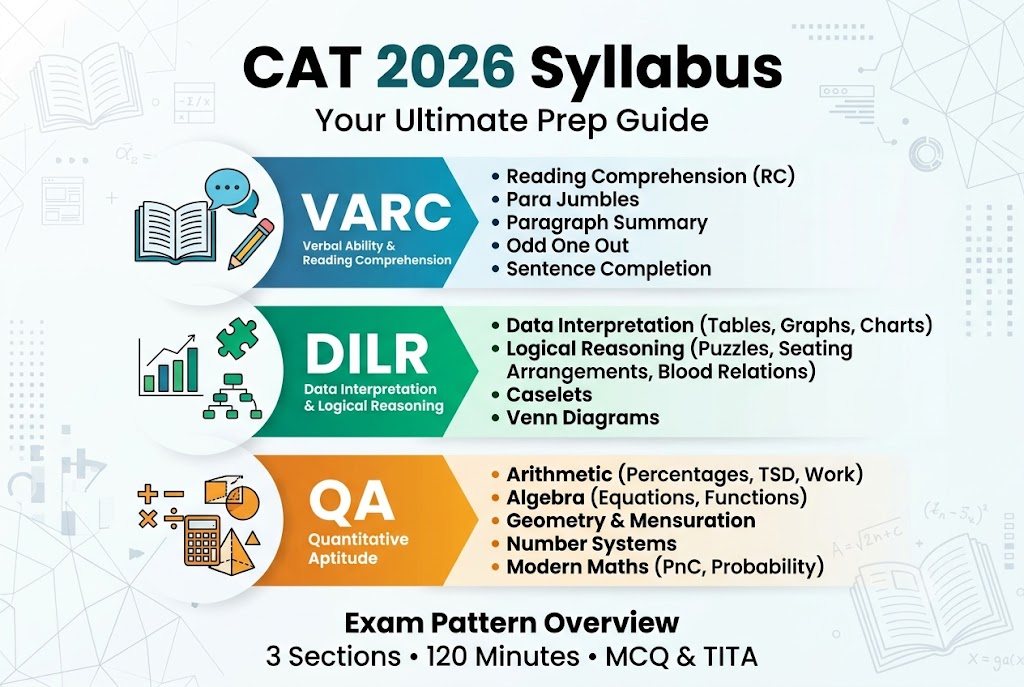
The CAT 2026 syllabus covers reading comprehension, verbal reasoning, data interpretation, logical reasoning, and quantitative mathematics. Although the official examination does not necessarily prescribe an exhaustive topic-by-topic syllabus, previous examination patterns provide a useful framework for preparation.
1. Verbal Ability and Reading Comprehension (VARC)
The VARC section evaluates a candidate’s ability to understand written material, identify arguments, interpret information, and analyze the meaning and structure of passages.
Important topics include:
- Reading Comprehension passages
- Main idea and central theme
- Inference-based questions
- Author’s tone and purpose
- Critical reasoning
- Para jumbles
- Para summary
- Sentence placement and insertion
- Odd sentence out
- Logical flow and paragraph structure
Preparation tips: Develop a daily reading habit by reading editorials, business articles, opinion pieces, and analytical essays. Focus on understanding the author’s argument rather than simply reading quickly. Practise identifying the central idea, supporting evidence, assumptions, and conclusions in each passage.
Regular timed practice can improve reading speed and comprehension accuracy. After attempting questions, review incorrect answers to understand whether the mistake resulted from misreading, weak inference, or confusion between similar options.
2. Data Interpretation and Logical Reasoning (DILR)
The DILR section tests analytical thinking, numerical interpretation, pattern recognition, and the ability to solve unfamiliar problems using available information.
Important topics include:
- Tables and charts
- Bar graphs and pie charts
- Line graphs
- Data comparison and caselets
- Arrangements and grouping
- Games and tournaments
- Scheduling problems
- Venn diagrams
- Binary logic
- Distribution and selection
- Networks and routes
- Logical puzzles
Preparation tips: Practise a variety of DILR sets rather than repeatedly solving only familiar question types. Start by understanding the conditions, organising the information, and identifying relationships between variables.
One of the most important skills in this section is set selection. During mock tests, learn to recognise sets that are comparatively straightforward and those that require extensive calculations or complex reasoning. Attempting the right sets can be more effective than spending the entire section on one difficult problem.
Maintain a notebook of recurring mistakes and revisit challenging sets after a few days to test whether you can solve them independently.
3. Quantitative Aptitude (QA)
The Quantitative Aptitude section measures mathematical understanding, numerical reasoning, and the ability to apply concepts to problem-solving situations.
Major topics include:
Arithmetic
- Percentages
- Profit and loss
- Ratio and proportion
- Averages
- Time and work
- Time, speed and distance
- Simple and compound interest
- Mixtures and alligation
Algebra
- Linear and quadratic equations
- Inequalities
- Functions
- Logarithms
- Sequences and series
- Algebraic expressions
Geometry and Mensuration
- Triangles
- Circles
- Quadrilaterals
- Polygons
- Coordinate geometry
- Area, volume, and surface area
Number Systems
- Divisibility
- Factors and multiples
- Prime numbers
- Remainders
- HCF and LCM
Modern Mathematics
- Permutations and combinations
- Probability
- Set theory
Preparation tips: Build a strong conceptual foundation before attempting advanced questions. Arithmetic is a useful starting point because it develops numerical reasoning applicable to several types of problems.
Create a formula notebook, revise important concepts regularly, and solve questions of increasing difficulty. During practice, focus on understanding the underlying method instead of memorising solutions. Shortcuts can help, but only when you understand why they work and when they can be applied.
CAT 2026 Preparation Strategy
A well-planned CAT 2026 preparation strategy should balance concept learning, practice, revision, and mock-test analysis. Candidates should customise their schedules according to their current proficiency, available time, and academic or professional commitments.
Step 1: Understand Your Current Preparation Level
Begin by taking a diagnostic mock test or attempting a selection of questions from all three sections. Analyse your performance to identify strengths, weaknesses, and areas that need additional practice.
This initial assessment helps you avoid spending excessive time on topics you already understand while neglecting important concepts that require improvement.
Step 2: Build Strong Fundamentals
Allocate sufficient time to understanding basic concepts in Quantitative Aptitude, Reading Comprehension, and Logical Reasoning. Candidates with weaker mathematics foundations should start with fundamental arithmetic and gradually move towards more complex topics.
For VARC, practise comprehension and logical interpretation. For DILR, focus on structured reasoning and data organisation.
Step 3: Follow a Consistent Study Schedule
A daily preparation schedule should include concept revision, question practice, and review of mistakes. For example, candidates might devote one session to Quantitative Aptitude, another to VARC, and a separate session to DILR.
The exact allocation should depend on your weaknesses. Consistency and focused practice are more valuable than an unrealistic timetable that is difficult to maintain.
Step 4: Practise Mock Tests Regularly
Mock tests help candidates understand the examination environment, practise time management, and evaluate their progress. Start with sectional tests when learning concepts and gradually increase the frequency of full-length mocks as the examination approaches.
After every test, review incorrect answers, unanswered questions, and questions that took too long to solve. This analysis can reveal whether you need better conceptual understanding, improved accuracy, or a different question-selection strategy.
Step 5: Revise and Track Performance
Maintain a record of mock scores, sectional accuracy, time spent per question, and frequently repeated errors. Use this information to identify trends and prioritise revision.
During the final preparation phase, focus on consolidating concepts and improving decision-making rather than attempting to learn every possible topic from scratch.
Career Mantra recommends a balanced preparation approach that combines realistic practice, regular revision, and a clear understanding of individual strengths and weaknesses.
CAT 2026 Selection Process and Admission Criteria
Qualifying for CAT is an important milestone, but it does not automatically guarantee admission to an IIM or another participating business school. Institutes conduct their own shortlisting and selection processes.
Stage 1: CAT Score and Percentile
After the examination, candidates receive their results according to the official evaluation process. Institutes may use the overall CAT percentile, sectional percentiles, and other eligibility requirements to shortlist applicants.
The minimum qualifying percentile varies by institute, programme, category, and admission cycle. Meeting a published minimum cutoff does not necessarily guarantee an interview invitation.
Stage 2: Shortlisting for Further Evaluation
Shortlisted candidates may be invited to participate in selection rounds such as:
- Written Ability Test (WAT)
- Personal Interview (PI)
- Group Discussion (GD), where applicable
- Other institute-specific assessments
Not every institute uses the same combination of selection rounds. Candidates should check the admissions policy for each programme they intend to apply to.
Stage 3: Final Merit List
Institutes may calculate a composite score using several factors, including CAT performance, academic records, interview performance, written assessment, work experience, and diversity-related criteria.
The weight assigned to each component differs between institutions and may change from one admission cycle to another. Therefore, aspirants should review the official selection criteria of their preferred business schools rather than relying on a single universal formula.
What Is a Good CAT 2026 Percentile?
The percentile required for admission depends on the institute, programme, category, and applicant pool. Highly competitive IIM programmes may require exceptionally strong overall and sectional percentiles, particularly for candidates applying under the General category.
However, there is no single percentile that guarantees admission to every top IIM. Shortlisting may also depend on academic performance, category-specific criteria, work experience, and other factors.
Candidates should use previous-year cutoffs as indicative references rather than guaranteed predictions for CAT 2026. It is also sensible to prepare a balanced list of target, competitive, and alternative MBA programmes based on individual academic profiles and career goals.
Career Opportunities After CAT 2026
CAT scores can help candidates apply to management programmes that prepare them for a wide range of professional roles. The opportunities available after graduation depend on the chosen specialisation, institute, industry, skills, and recruitment market.
Popular MBA career paths include:
- Marketing Management: Brand management, marketing strategy, market research, and digital marketing.
- Finance: Financial analysis, corporate finance, investment-related roles, and risk management.
- Human Resource Management: Talent acquisition, employee engagement, and organisational development.
- Business Analytics: Business intelligence, data-driven decision-making, and analytics consulting.
- Operations and Supply Chain: Process improvement, logistics, procurement, and supply chain planning.
- Consulting: Business strategy, operational consulting, and management advisory.
- Entrepreneurship: Business development, startup management, and venture creation.
Candidates should assess the curriculum, placement reports, industry exposure, alumni network, and total programme cost before selecting an MBA institution.
Why Choose Career Mantra for MBA Admission Guidance?
Choosing the right management programme involves more than preparing for an entrance examination. Aspirants must also evaluate colleges, understand admission requirements, compare specialisations, and identify opportunities that match their career goals.
Career Mantra aims to help students make informed education and career decisions by providing relevant information about entrance examinations, management programmes, college admissions, and career pathways.
Through its educational resources, students can explore topics such as CAT preparation, MBA eligibility, entrance exam updates, college comparisons, placement information, and admission procedures.
Before making an admission decision, aspirants should independently verify important information, including programme fees, placement statistics, eligibility criteria, and deadlines, through official institutional sources.
For candidates preparing for CAT 2026, combining a structured study plan with careful college research can help create a more informed approach to management education.
Conclusion
CAT 2026 is an important opportunity for graduates and aspiring managers who want to pursue postgraduate management education at leading business schools in India. A clear understanding of eligibility, the examination structure, the syllabus, and the selection process can help candidates approach the test with greater confidence.
Successful preparation requires more than completing the syllabus. Candidates should develop strong fundamentals, practise questions under timed conditions, analyse mock-test performance, and revise consistently. They should also research potential MBA institutions carefully because admission policies, placement outcomes, fees, and specialisations vary significantly.
As you plan your preparation, use reliable resources, track official announcements, and set realistic performance goals. Career Mantra encourages aspirants to combine disciplined CAT preparation with informed college selection so they can make better decisions about their management education and future careers.
Start with a clear study plan, evaluate your progress regularly, and stay focused on continuous improvement. With consistent effort and a thoughtful approach, you can work towards achieving your CAT 2026 goals and exploring the management opportunities that best suit your ambitions.
Frequently Asked Questions (FAQs)
1. What is CAT 2026?
CAT 2026 is the Common Admission Test used by the Indian Institutes of Management and other participating institutions as part of their MBA and postgraduate management admission processes. The examination assesses verbal ability, reading comprehension, data interpretation, logical reasoning, and quantitative aptitude.
2. What is the eligibility criteria for CAT 2026?
Candidates generally need a bachelor’s degree with at least 50% aggregate marks or an equivalent CGPA. The usual minimum is 45% for SC, ST, and PwD candidates. Final-year students may also apply subject to the prescribed requirements. Candidates should verify the official notification for complete eligibility details.
3. What is the CAT 2026 exam date?
The date provided in the proposed schedule for CAT 2026 is November 29, 2026. Candidates should confirm the date, examination sessions, and reporting instructions through the official CAT website before making travel or examination-day arrangements.
4. How many questions are expected in CAT 2026?
The supplied examination pattern lists approximately 66 questions across VARC, DILR, and Quantitative Aptitude. The final number of questions and maximum marks should be verified against the official examination notification.
5. Is there negative marking in CAT 2026?
CAT generally awards three marks for a correct answer and deducts one mark for an incorrect multiple-choice question. Non-MCQ questions generally do not carry negative marking. Candidates should follow the marking instructions provided for their examination.
6. Can final-year students apply for CAT 2026?
Yes, final-year undergraduate students are generally eligible to apply if they meet the prescribed conditions. They must complete the required academic formalities and provide supporting documents according to the admission requirements of their chosen institutions.
7. Is work experience mandatory for CAT or IIM admission?
No, work experience is not mandatory to appear for CAT. Fresh graduates and working professionals can both apply. However, certain IIMs may award weight to professional experience when calculating shortlisting or final admission scores.
8. Can I use a calculator during CAT 2026?
Candidates generally cannot carry a physical calculator into the examination hall. An on-screen calculator is usually available through the examination interface. Aspirants should check the official test-day instructions for the permitted tools and restrictions.
9. Is there a sectional time limit in CAT 2026?
CAT traditionally follows a sectional time limit of 40 minutes for each of the three sections, making the standard examination duration 120 minutes. Candidates generally cannot switch between sections during their allotted time.
10. How should I prepare for CAT 2026 in the final months?
Focus on full-length mock tests, sectional practice, revision, and detailed error analysis. Strengthen weak concepts, practise question selection, and maintain a daily reading habit. Avoid making major changes to your strategy without reviewing your performance data.
11. Does a high CAT percentile guarantee admission to an IIM?
No. A high percentile can improve an applicant’s competitiveness, but admission also depends on each institute’s shortlisting criteria, academic profile, category, interview performance, and other selection components.
12. Where can I check official CAT 2026 updates?
Candidates should visit the official website at iimcat.ac.in for verified announcements about registration, eligibility, the examination schedule, admit cards, answer keys, results, and other instructions. Career Mantra can also serve as an educational resource for understanding the examination and exploring management admission information.
Follow Career Mantra for More Updates
Follow Career Mantra for education updates, entrance-exam guidance, college comparisons, admission tips and career resources.
Leave a comment