


Complete Guide to XAT 2026: Syllabus, Exam Pattern, Eligibility Criteria & More
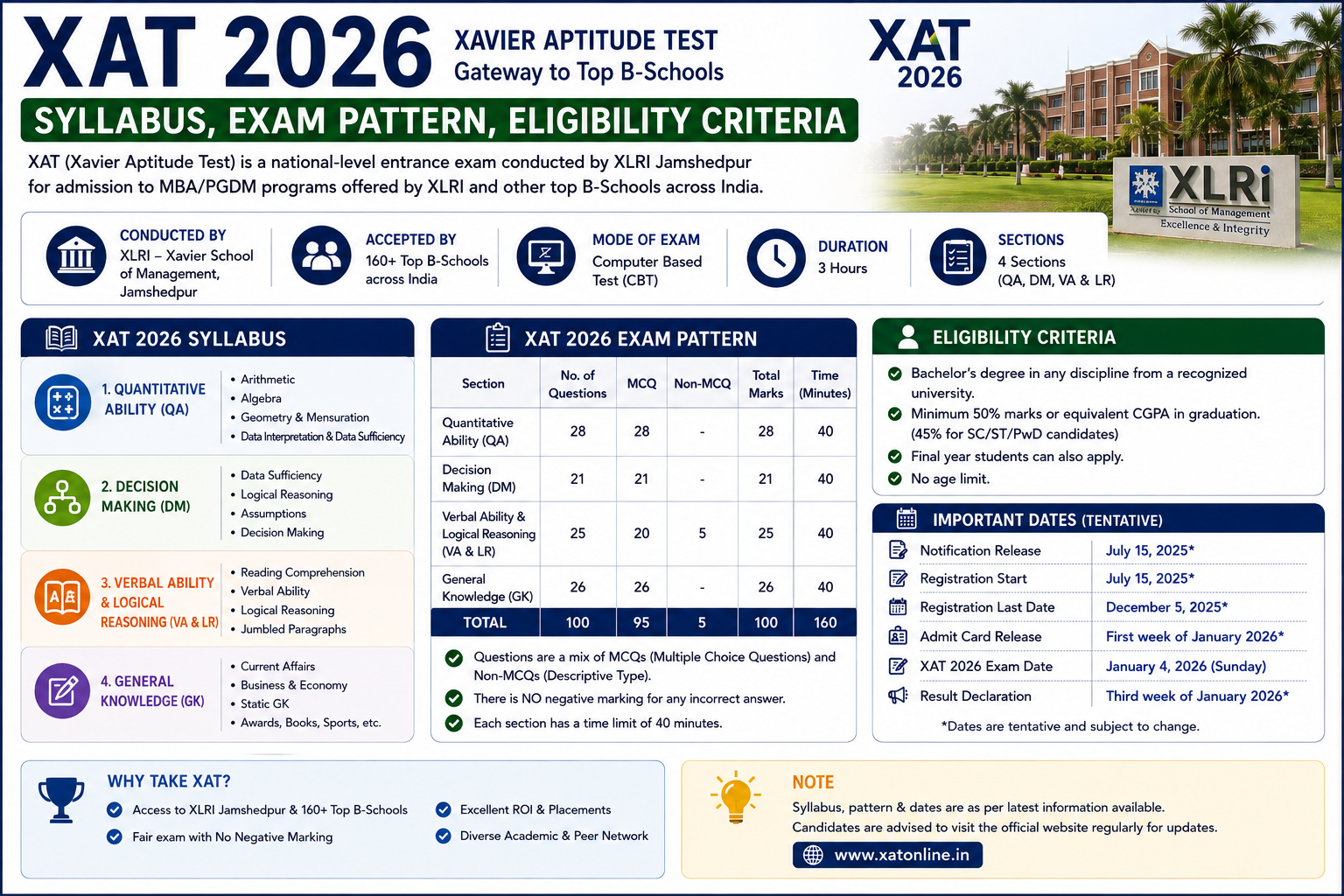
The Xavier Aptitude Test (XAT) 2026 was a national-level MBA entrance examination conducted by XLRI – Xavier School of Management, Jamshedpur. XAT scores are accepted by XLRI and numerous other management institutes across India for admission to MBA and PGDM programmes.
XAT is different from exams such as CAT because it includes a dedicated Decision Making section along with Verbal Ability and Logical Reasoning, Quantitative Aptitude and Data Interpretation, and General Knowledge.
If you are preparing for a future XAT cycle, this guide covers the XAT syllabus, exam pattern, eligibility, fees, marking scheme, books and preparation strategy.
XAT 2026 Overview
| Feature | Details |
|---|---|
| Exam Name | Xavier Aptitude Test (XAT) 2026 |
| Conducting Body | XLRI – Xavier School of Management |
| Exam Mode | Computer-Based Test |
| Frequency | Once a year |
| Major Sections | VA & LR, Decision Making, QA & DI, GK |
| Exam Date | January 2026 |
| Exam Duration | Approximately 180 minutes |
XAT 2026 Syllabus
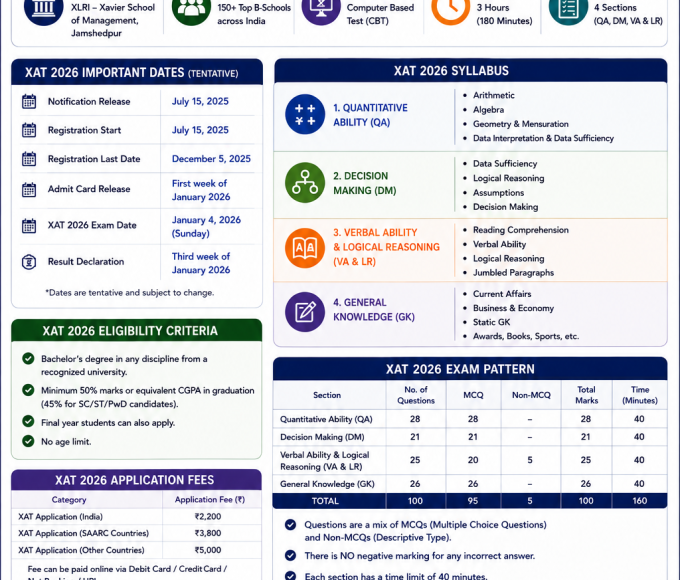
The XAT syllabus consists of four major sections. Candidates should prepare each section separately because the skills tested are different.
1. Verbal Ability & Logical Reasoning
This section evaluates English language ability, reading comprehension and logical reasoning.
Important topics include:
- Reading Comprehension
- Vocabulary
- Grammar
- Para Jumbles
- Sentence Completion
- Critical Reasoning
- Inference-based questions
- Logical reasoning
Preparation Tip: Read newspapers, editorials and quality articles regularly. Practise RC and logical reasoning questions under timed conditions.
2. Decision Making
Decision Making is one of the most important and distinctive sections of XAT.
Questions are generally based on practical situations and caselets.
Important areas include:
- Ethical dilemmas
- Business situations
- Situational judgement
- Case-based reasoning
- Analytical decision making
- Stakeholder-based decisions
- Logical evaluation of alternatives
Preparation Tip: Solve previous-year XAT Decision Making questions. Focus on identifying the most logical, ethical and practical solution rather than relying on personal opinions.
3. Quantitative Aptitude & Data Interpretation
QA & DI tests mathematical concepts, numerical ability and data-analysis skills.
Important topics include:
- Percentages
- Profit and Loss
- Ratio and Proportion
- Averages
- Time and Work
- Time, Speed and Distance
- Mixtures and Alligation
- Algebra
- Equations
- Number System
- Geometry
- Mensuration
- Probability
- Permutation and Combination
- Tables
- Graphs
- Charts
- Data Interpretation
Preparation Tip: Build strong fundamentals in Arithmetic and Algebra before moving to advanced questions. Practise calculations regularly.
4. General Knowledge
The GK section tests awareness of current and static events.
Important areas include:
- Current Affairs
- Business and Economy
- National Events
- International Events
- Government policies
- Awards
- Sports
- Books and Authors
- Science and Technology
- Important organisations
- History and Geography
Preparation Tip: Read current-affairs news regularly and revise important events from the previous several months.
XAT 2026 Application Fees
The XAT application fee is announced by XLRI during the registration process. Candidates should always verify the latest fee through the official XAT registration portal.
The fee may vary depending on whether a candidate applies to XLRI programmes in addition to the XAT examination.
| Application | Fee |
|---|---|
| XAT Registration | As notified by XLRI |
| XLRI Programme Add-on | Additional fee may apply |
XAT 2026 Eligibility Criteria
Candidates generally need to meet the following requirements:
- A recognised Bachelor’s degree in any discipline.
- The degree should generally be of at least three years’ duration.
- Final-year graduation students can apply, subject to the applicable conditions.
- There is generally no upper age limit.
- There is no prescribed limit on the number of XAT attempts.
However, individual institutes and programmes may have additional eligibility requirements.
XAT 2026 Exam Pattern
The XAT examination consists of four major sections.
| Section | Approx. Questions |
|---|---|
| Verbal Ability & Logical Reasoning | 26 |
| Decision Making | 21 |
| Quantitative Aptitude & Data Interpretation | 28 |
| General Knowledge | 20 |
| Total | 95 |
The exact number of questions and duration may change between examination cycles, so candidates should check the latest official notification.
XAT Marking Scheme
The commonly followed marking system includes:
- +1 mark for every correct answer
- -0.25 mark for an incorrect answer
- A penalty may apply for excessive unanswered questions
- GK is treated separately from the sections used for the main aptitude score
Candidates should verify the final marking rules in the official notification for their examination cycle.
Best Books for XAT Preparation
| Section | Recommended Resources |
|---|---|
| Verbal & Logical Ability | Arun Sharma’s VARC preparation books |
| Decision Making | XAT Decision Making practice books and previous-year papers |
| Quantitative Aptitude & DI | Arun Sharma’s QA books, Sarvesh Verma’s Quantitative Aptitude resources |
| General Knowledge | Manorama Yearbook, Lucent’s GK and current-affairs resources |
Previous-year XAT papers should be an important part of your preparation because they help you understand the exam’s question style.
XAT 2026 Preparation Strategy
Strengthen Your Fundamentals
Start with basic concepts in QA, VARC, Logical Reasoning and Data Interpretation.
Give Extra Attention to Decision Making
Decision Making is a distinctive part of XAT. Practise caselets regularly and analyse the official or expert solutions carefully.
Improve Reading Skills
Regular reading can improve comprehension, vocabulary and critical reasoning.
Follow Current Affairs
Read business, economic, national and international news regularly for the GK section.
Practise Previous-Year Papers
Previous XAT papers help you understand difficulty levels and recurring question patterns.
Take Mock Tests
Start with sectional tests and gradually move to full-length XAT mocks. Analyse your performance after every test.
XAT vs CAT
| Feature | CAT | XAT |
|---|---|---|
| Conducting Body | IIMs | XLRI |
| Major Unique Area | DILR | Decision Making + GK |
| Exam Mode | Computer-Based | Computer-Based |
| Major Institutes | IIMs and CAT-accepting B-schools | XLRI and XAT-accepting B-schools |
Candidates targeting XLRI and other XAT-accepting institutes should consider XAT as an important part of their MBA entrance preparation.
Final Thoughts
The XAT 2026 exam required candidates to prepare across Verbal Ability and Logical Reasoning, Decision Making, Quantitative Aptitude and Data Interpretation, and General Knowledge.
Unlike CAT, XAT places significant emphasis on Decision Making, making regular case-based practice essential. Candidates should combine conceptual preparation with previous-year papers, mock tests, current-affairs reading and detailed performance analysis.
For future XAT cycles, always check the latest official notification, registration dates, application fees, eligibility requirements, exam pattern and admission criteria before applying.
Also read:
- MBA schools by CAT percentile
- CAT percentile vs MBA college
- CAT cutoff for IIMs
- MBA admission by CAT score
- CAT accepting colleges 2026
- MBA colleges for 70 percentile in CAT
- Top B-schools by CAT score

Leave a comment