


All About CAT Entrance Exam 2026: Syllabus, Fees, Eligibility & More The Common Admission Test (CAT) is one of India’s most important MBA entrance examinations. CAT scores are used for admission to the Indian Institutes of Management (IIMs) and numerous other management institutes across India.
If you are planning to appear for CAT 2026, understanding the exam pattern, eligibility, syllabus, application fee, and preparation strategy can help you plan your preparation effectively. This guide covers the key details you need to know about the CAT Entrance Exam 2026.
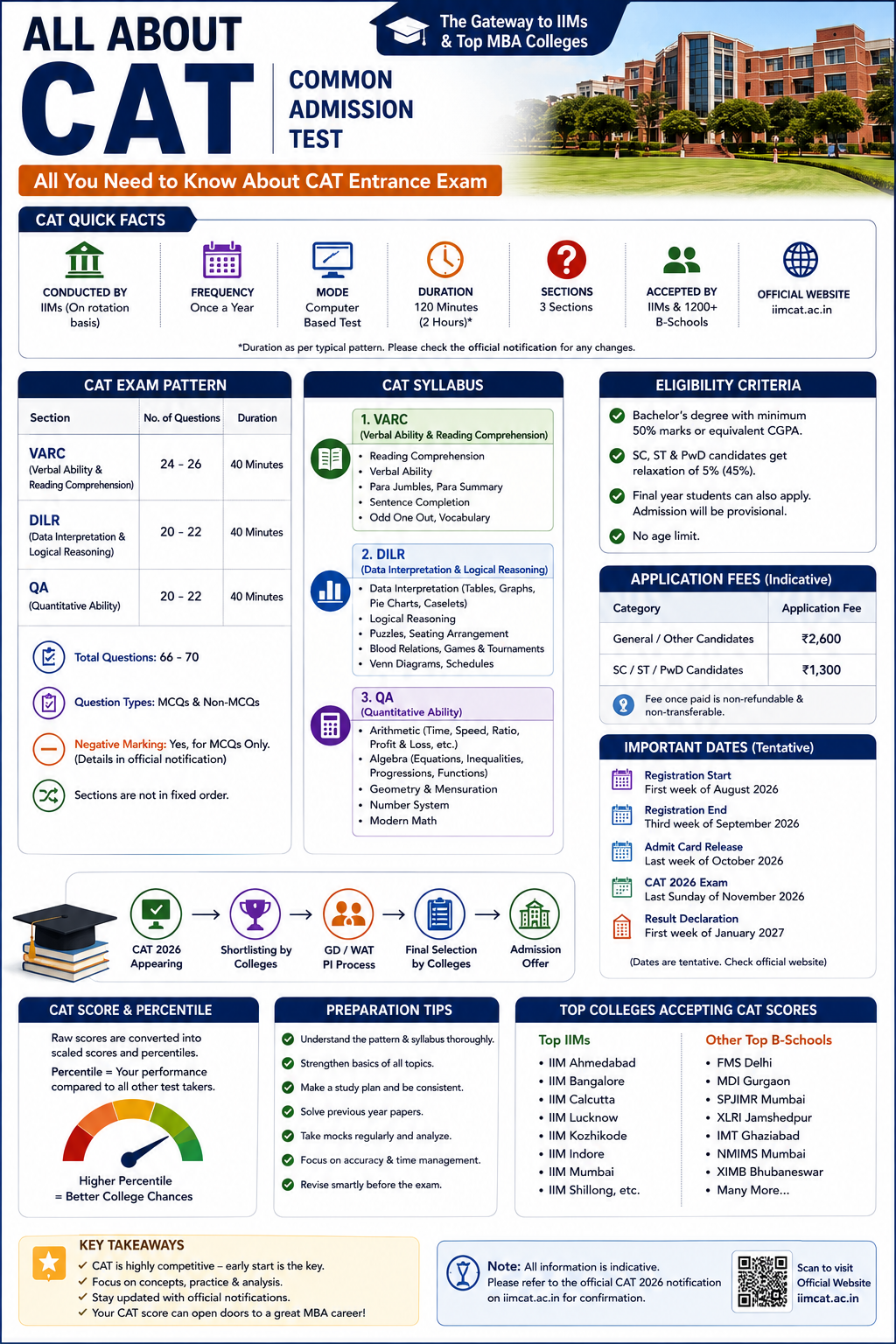
All about CAT Entrance Exam 2026 Overview
| Feature | Details |
|---|---|
| Exam Name | Common Admission Test (CAT) |
| Conducting Body | Indian Institutes of Management |
| Exam Mode | Computer-Based Test (CBT) |
| Frequency | Once a year |
| Exam Duration | 120 minutes |
| Total Questions | 68* |
| Sections | VARC, DILR, QA |
| Sectional Time | 40 minutes each |
| Exam Date | Expected in November 2026* |
*The final CAT 2026 exam date, question count, and other details should be confirmed through the official CAT 2026 notification.
CAT 2026 Exam Syllabus
The IIMs do not normally publish a detailed chapter-wise CAT syllabus. However, previous CAT papers indicate three major sections.
1. Verbal Ability and Reading Comprehension (VARC)
VARC evaluates reading comprehension, interpretation, verbal reasoning, and the ability to understand arguments.
Important areas include:
- Reading Comprehension
- Para Jumbles
- Para Summary
- Odd Sentence Out
- Main idea and inference
- Author’s tone and purpose
- Vocabulary in context
Preparation Tip: Read newspapers, editorials, magazines, and long-form articles regularly. Practise RC passages under timed conditions.
2. Data Interpretation and Logical Reasoning (DILR)
DILR tests analytical thinking, data interpretation, logical reasoning, and problem-solving skills.
Important topics include:
- Tables
- Bar graphs
- Line graphs
- Pie charts
- Caselets
- Seating arrangements
- Distribution
- Scheduling
- Games and tournaments
- Venn diagrams
- Networks
- Logical puzzles
Preparation Tip: Practise different types of DILR sets regularly and learn to identify easier sets before spending time on difficult ones.
3. Quantitative Aptitude (QA)
QA evaluates mathematical concepts and numerical problem-solving ability.
Important topics include:
- Percentages
- Profit and Loss
- Ratio and Proportion
- Averages
- Time and Work
- Time, Speed and Distance
- Mixtures and Alligation
- Algebra
- Equations and Inequalities
- Number System
- Geometry
- Mensuration
- Permutation and Combination
- Probability
- Set Theory
Preparation Tip: Build strong fundamentals first, then practise increasingly difficult questions while improving calculation speed and accuracy.
CAT 2026 Application Fee
The CAT application fee is notified officially for each examination cycle. Candidates should check the official CAT 2026 notification before submitting the application because fees can be revised.
For reference, the fee structure in recent CAT cycles has been:
| Category | Application Fee |
|---|---|
| General / EWS / NC-OBC | ₹2,600* |
| SC / ST / PwD | ₹1,300* |
*Candidates should verify the final CAT 2026 fee when registration opens.
CAT 2026 Eligibility Criteria
Candidates generally need to satisfy the following requirements:
- A recognised Bachelor’s degree with at least 50% marks or equivalent CGPA.
- Candidates belonging to SC, ST and PwD categories generally require at least 45% marks or equivalent CGPA.
- Candidates appearing in the final year of their bachelor’s degree can apply, subject to the applicable conditions.
- There is generally no upper age limit for CAT.
- Candidates can appear for CAT multiple times because there is no prescribed limit on attempts.
Candidates should carefully check the official CAT 2026 notification for the exact eligibility requirements.
CAT 2026 Exam Pattern
The currently reported CAT pattern consists of three separately timed sections.
| Section | Questions | Time |
|---|---|---|
| VARC | 24 | 40 minutes |
| DILR | 22 | 40 minutes |
| QA | 22 | 40 minutes |
| Total | 68 | 120 minutes |
The examination generally includes MCQ and TITA (Type In The Answer) questions.
CAT Marking Scheme
- +3 marks for a correct answer
- -1 mark for an incorrect MCQ
- TITA questions generally do not carry negative marking
Candidates should verify the final marking scheme in the CAT 2026 official notification.
Best Books for CAT 2026 Preparation
| Section | Recommended Books |
|---|---|
| VARC | How to Prepare for Verbal Ability and Reading Comprehension for CAT – Arun Sharma |
| VARC | Word Power Made Easy – Norman Lewis |
| DILR | Logical Reasoning and Data Interpretation for CAT – Nishit K. Sinha |
| QA | How to Prepare for Quantitative Aptitude for CAT – Arun Sharma |
Along with books, candidates should practise previous-year CAT questions, sectional tests, and full-length mock tests.
CAT 2026 Preparation Strategy
A successful CAT preparation strategy should focus on three areas: concepts, practice, and analysis.
Build Your Fundamentals
Begin with basic concepts in Arithmetic, Algebra, RC, DI and Logical Reasoning.
Practise Daily
Maintain a consistent study schedule. Even one or two hours of focused practice every day can be more effective than irregular long study sessions.
Solve Previous-Year Questions
CAT previous-year questions help you understand the difficulty level, question patterns, and types of concepts tested.
Take Mock Tests
Once you have covered the fundamentals, start taking sectional and full-length mocks.
Analyse Your Performance
Do not focus only on your mock score. Analyse:
- Incorrect answers
- Unattempted easy questions
- Time-consuming questions
- Calculation errors
- Conceptual weaknesses
- Question-selection mistakes
CAT 2026: Final Preparation Tips
- Read regularly to improve VARC.
- Strengthen Arithmetic and Algebra fundamentals.
- Practise DILR sets frequently.
- Improve calculation speed.
- Maintain an error notebook.
- Revise formulas regularly.
- Take timed sectional tests.
- Analyse every mock test carefully.
- Focus on accuracy rather than blind attempts.
- Develop a clear question-selection strategy.
Final Thoughts
The CAT Entrance Exam 2026 is a test of conceptual understanding, logical thinking, speed, accuracy, and time management. Completing the syllabus is only the first step. Consistent practice, previous-year questions, mock tests, and detailed performance analysis are essential for achieving a strong percentile.
A good CAT score can help you compete for admission to leading management institutes, including the IIMs, FMS Delhi, MDI Gurgaon, IIT management schools, SPJIMR, and other reputed B-schools.
Before applying, always verify the latest CAT 2026 exam date, application fee, eligibility criteria, registration dates, and exam pattern through the official CAT notification.


Leave a comment