CAT 2026 Preparation for Beginners: Ultimate Study Plan, Crash Course, Books & Expert Tips
Introduction
The Common Admission Test (CAT) is one of India's most competitive management entrance examinations and a major pathway to MBA programs offered by the Indian Institutes of Management (IIMs) and other leading business schools. For students aspiring to build careers in management, consulting, finance, marketing, business analytics, or entrepreneurship, securing a strong CAT percentile can open doors to valuable academic and professional opportunities.If you are starting from scratch, CAT 2026 preparation for beginners may initially seem challenging because the examination tests multiple skills, including reading comprehension, logical reasoning, data interpretation, and mathematical problem-solving. However, with a structured study plan, consistent practice, and regular mock-test analysis, beginners can make meaningful progress.
The key is to understand the examination before starting preparation, strengthen fundamental concepts, and gradually improve speed and accuracy. Candidates preparing during the final weeks before the examination should also adopt a focused crash course strategy instead of attempting to learn every topic in excessive detail.
In this guide, Career Mantra explains how to start CAT preparation as a beginner, create a realistic study timetable, select useful books and online resources, prepare section-wise, and make the most of the remaining preparation time. Whether you have several months or are looking for a last-minute revision plan, this guide will help you organize your efforts effectively.
CAT 2026 Exam Overview
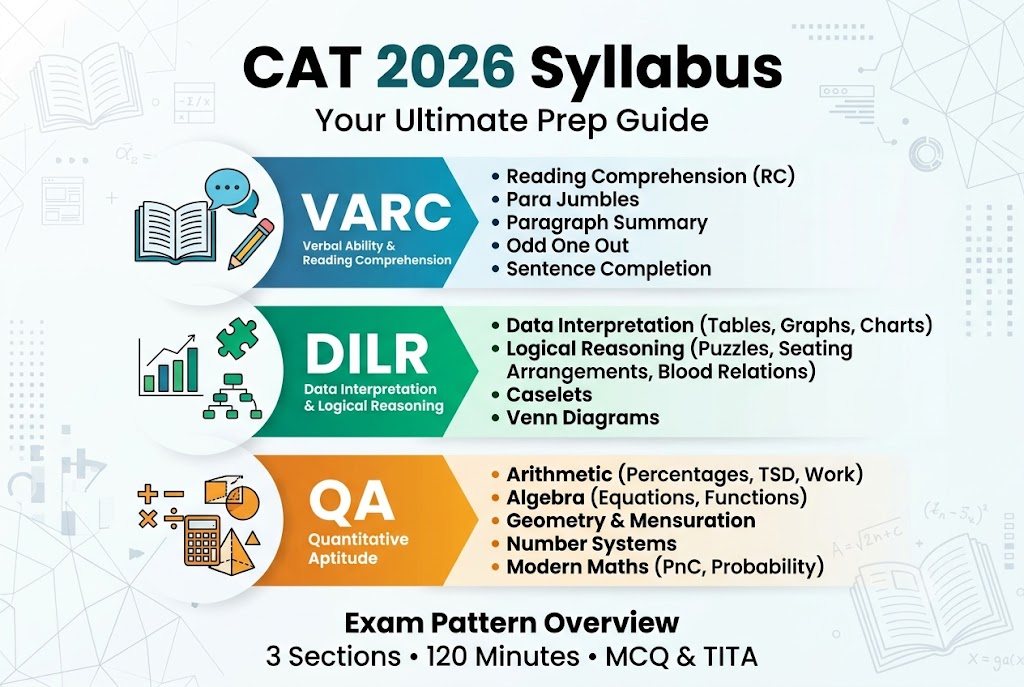
Before beginning your preparation, understand the basic structure of the examination. CAT generally assesses candidates through three sections, each designed to evaluate different academic and analytical abilities.
| Particulars | Details |
|---|---|
| Exam Name | Common Admission Test (CAT) 2026 |
| Conducting Authority | Designated Indian Institute of Management |
| Examination Mode | Computer-Based Test |
| Frequency | Once a year |
| Duration | Generally 120 minutes |
| Sections | VARC, DILR, and Quantitative Aptitude |
| Admission Opportunities | IIMs and other CAT-accepting business schools |
| Official Website | iimcat.ac.in |
The examination date and final test structure should be verified through the official CAT 2026 notification.
Understanding the Three Sections
Verbal Ability and Reading Comprehension (VARC): Tests reading comprehension, interpretation, verbal reasoning, and the ability to understand arguments.
Data Interpretation and Logical Reasoning (DILR): Evaluates analytical thinking, data interpretation, logical deduction, and problem-solving.
Quantitative Aptitude (QA): Assesses mathematical concepts, numerical ability, and the application of quantitative techniques.
A successful preparation strategy must address all three sections. Concentrating only on your strongest subject may limit your overall performance, particularly if your target institutes apply sectional cutoffs.
CAT 2026 Preparation for Beginners: How to Get Started
Beginners should avoid starting with difficult questions or attempting full-length mock tests every day without understanding the fundamentals. Instead, follow a systematic process that helps you identify your current level and improve gradually.
Step 1: Understand the Syllabus and Exam Pattern
Begin by reviewing the major topics covered in VARC, DILR, and Quantitative Aptitude. Familiarize yourself with the examination duration, sectional time limits, question types, and marking scheme.
Step 2: Take a Diagnostic Mock Test
Attempt one mock test or a selection of previous CAT questions before beginning intensive preparation. Do not worry if your initial score is low.
The purpose is to identify your strengths and weaknesses. For example, you may find that you understand mathematical concepts but take too long to solve questions, or that you can read passages quickly but struggle with inference-based questions..
Step 3: Build Strong Fundamentals
Start with basic concepts before progressing to advanced problems. In quantitative aptitude, revise arithmetic, percentages, ratios, averages, and algebra. In VARC, practise comprehension and logical interpretation. For DILR, begin with straightforward tables, arrangements, and puzzles.
Understanding concepts properly makes it easier to solve unfamiliar questions later.
Step 4: Practice Consistently
Regular practice is essential for improving accuracy and familiarity with different question types. Solve questions every day and review your mistakes carefully.
Instead of measuring progress only by the number of questions completed, focus on whether you understand the solutions and can apply the same concepts independently.
Step 5: Review Your Progress Weekly
At the end of each week, review completed topics, mock-test scores, recurring mistakes, and areas that need additional practice.
Career Mantra recommends adjusting your study schedule according to your performance rather than following a rigid timetable that does not address your weaknesses.
CAT 2026 Preparation Timeline for Beginners
The ideal preparation timeline depends on when you start and how comfortable you are with the syllabus. Since the November 2026 examination is approaching, candidates beginning now should prioritize essential concepts, previous-year questions, mock tests, and revision.
The following schedule is designed for aspirants preparing during the final weeks before the examination. Confirm the examination date through the official website.
| Preparation Phase | Main Focus | Recommended Activities |
|---|---|---|
| Week 1 | Diagnostic assessment and fundamentals | Attempt a diagnostic test, revise arithmetic, and begin daily reading. |
| Week 2 | Core concepts and basic practice | Cover essential QA topics and practice introductory DILR sets. |
| Week 3 | Sectional practice | Solve timed VARC, DILR, and QA exercises and review errors. |
| Week 4 | Mock-test improvement | Attempt full-length mocks and analyze weak areas. |
| Week 5 | Revision and exam strategy | Revise formulas, practice selected previous-year questions, and refine time management. |
| Final days | Focused revision | Review error notes, maintain a balanced routine, and avoid unnecessary new topics. |
This is an intensive crash course schedule, not a guarantee of complete syllabus coverage. Candidates with weaker fundamentals may need to prioritise high-value topics rather than attempting every chapter.
For future CAT cycles, starting several months in advance allows more time for concept building, practice, revision, and gradual mock-test improvement.
Section-Wise CAT 2026 Preparation Strategy
1. Verbal Ability and Reading Comprehension (VARC)
VARC can be challenging for beginners because success depends on comprehension, interpretation, and logical reasoning rather than memorising vocabulary alone.
Important topics include:
- Reading Comprehension
- Main idea and central theme
- Author's tone and purpose
- Inference-based questions
- Critical reasoning
- Para summary
- Para jumbles
- Odd sentence out
- Sentence placement and paragraph structure
How to Prepare for VARC
Develop a daily reading habit. Read editorials, opinion articles, business news, and analytical essays. Focus on understanding the author's argument, supporting evidence, and conclusions.
Practise reading comprehension regularly. Start with one or two passages daily, depending on your available time. Gradually increase the difficulty and practice answering questions under timed conditions.
Improve comprehension rather than memorising words. Vocabulary building can be useful, but the ability to interpret context and understand arguments is particularly important.
Review incorrect answers. When you make a mistake, determine whether it resulted from misreading, misunderstanding an inference, or choosing an option that was too broad or too narrow.
Recommended resources include Word Power Made Easy by Norman Lewis for vocabulary development and CAT-focused VARC practice books. Reading quality editorials can supplement your preparation.
2. Data Interpretation and Logical Reasoning (DILR)
DILR evaluates your ability to organize information, identify relationships, and solve problems logically. Beginners may initially find this section difficult because many questions require multiple steps rather than a single formula.
Important topics include:
- Tables and data comparison
- Bar graphs and pie charts
- Line graphs and caselets
- Arrangements and grouping
- Scheduling problems
- Games and tournaments
- Selection and distribution
- Venn diagrams
- Logical puzzles
- Networks and routes
How to Prepare for DILR
Start with simple sets. Learn to organize information systematically using tables, diagrams, and short notes.
Practise one or two sets daily. Focus on understanding the conditions and identifying the relationships between variables. Increase the complexity as your confidence improves.
Learn to select questions strategically. Not every set is equally manageable within the available time. During practice, compare the time required to solve different sets and learn to identify relatively accessible ones.
Analyze the solution process. If you cannot solve a set, study the reasoning behind the solution, close the explanation, and attempt the set again independently.
Useful resources include CAT previous-year DILR questions and recognized CAT preparation books, such as DILR materials by Nishit K. Sinha.
3. Quantitative Aptitude (QA)
Quantitative Aptitude assesses mathematical understanding and the ability to solve numerical problems accurately. Beginners who have not studied mathematics recently should spend sufficient time revising basic concepts.
Major topics include:
Arithmetic
- Percentages
- Profit and loss
- Ratio and proportion
- Averages
- Time and work
- Time, speed and distance
- Simple and compound interest
- Mixtures and alligation
Algebra
- Linear and quadratic equations
- Inequalities
- Functions
- Logarithms
- Sequences and series
Geometry and Mensuration
- Triangles
- Circles
- Quadrilaterals
- Areas and volumes
- Coordinate geometry
Number Systems and Modern Mathematics
- Divisibility
- Factors and multiples
- Remainders
- Permutations and combinations
- Probability
- Set theory
How to Prepare for Quantitative Aptitude
Revise basic mathematics. Make sure you understand fractions, percentages, ratios, equations, and elementary calculations before moving to advanced questions.
Practise approximately 15–20 questions daily when time permits. Prioritise accuracy and conceptual understanding rather than completing questions as quickly as possible.
Create a formula notebook. Record important formulas, shortcuts, and concepts that you frequently forget. Review them regularly.
Learn from mistakes. If a question takes too long, identify whether the difficulty comes from weak fundamentals, calculation errors, or an inefficient approach.
Recommended resources include Quantitative Aptitude for CAT by Arun Sharma, CAT-focused material by recognised preparation providers, and selected NCERT mathematics chapters for revising fundamentals.
CAT 2026 Crash Course Plan for Last-Minute Preparation
A crash course is useful for candidates who have limited time before the examination. However, it should focus on improving existing knowledge and examination strategy rather than promising mastery of the entire syllabus within a few days.
Seven-Day Revision Plan
| Day | Preparation Focus |
|---|---|
| Day 1 | Take a mock test and identify the three most important weaknesses |
| Day 2 | Revise arithmetic and practise selected QA questions |
| Day 3 | Practise VARC passages, inference questions, and paragraph-based exercises |
| Day 4 | Solve DILR sets and revise data interpretation techniques |
| Day 5 | Attempt a full-length mock and analyse every section |
| Day 6 | Revise formulas, review errors, and practise selected weak areas |
| Day 7 | Review strategy, organise examination essentials, and maintain a calm routine |
If you have more than one week remaining, repeat the cycle with additional revision and mock-test analysis. Adjust the schedule according to your actual preparation level.
Avoid attempting multiple difficult mocks without analysing them. One carefully reviewed mock can provide more useful feedback than several tests completed without reflection.
CAT Mock Test Strategy for Beginners
Mock tests help candidates understand the examination environment, practise time management, and evaluate their readiness. However, the frequency of mocks should increase gradually as your conceptual understanding improves.
| Preparation Stage | Suggested Frequency | Primary Goal |
|---|---|---|
| Foundation | One mock every two weeks, if appropriate | Understand the format and identify weaknesses |
| Practice | One or two mocks per week | Improve accuracy and timing |
| Final phase | Around two or three mocks per week, if sustainable | Refine strategy and examination readiness |
These are suggested frequencies rather than mandatory targets. Beginners with limited preparation may benefit more from sectional tests before increasing full-length mock frequency.
How to Analyse a Mock Test
After every mock, review:
- Questions answered correctly and incorrectly.
- Questions left unattempted despite being manageable.
- Time spent on difficult questions.
- Concepts that repeatedly cause mistakes.
- Sectional performance and accuracy.
- Opportunities to improve question selection.
Maintain an error log and revisit recurring mistakes during revision. Do not judge your preparation based on a single mock score; evaluate performance trends over several tests.
Daily Study Routine for CAT 2026 Beginners
A realistic timetable should balance concept learning, practice, revision, and rest. The following routine is suitable for candidates who can dedicate approximately five hours per day.
| Time Slot | Activity | Duration |
|---|---|---|
| Morning | Editorial reading and VARC practice | 1 hour |
| Late Morning | Quantitative Aptitude concepts and questions | 1.5 hours |
| Afternoon | DILR practice sets | 1 hour |
| Evening | Sectional practice or previous-year questions | 1 hour |
| Night | Formula revision and error-log review | 30 minutes |
Working professionals and college students can divide these sessions into shorter periods throughout the day. The key is consistency rather than following an inflexible timetable.
During mock-test days, replace some individual practice sessions with a full-length test and detailed analysis.
Best Books and Online Resources for CAT 2026 Preparation
Choosing suitable preparation resources can help beginners avoid confusion and unnecessary repetition. You do not need to purchase every available book or join several coaching programmes simultaneously.
Recommended Books
- Quantitative Aptitude: How to Prepare for Quantitative Aptitude for CAT by Arun Sharma.
- VARC and Vocabulary: Word Power Made Easy by Norman Lewis, supplemented with CAT-focused reading comprehension practice.
- DILR: CAT-focused data interpretation and logical reasoning material by Nishit K. Sinha.
- Fundamental Mathematics: Selected NCERT mathematics chapters for revising basic concepts.
Online Learning Resources
Candidates can explore educational content and practice material from established CAT preparation providers, including:
- Cracku
- 2IIM
- Unacademy
- IMS
- T.I.M.E.
- Career Launcher
Check each provider's current offerings, costs, mock-test coverage, and suitability before enrolling.
Career Mantra can also be used as an educational resource for exploring entrance examinations, MBA colleges, admission criteria, and management education opportunities.
Important: Select a small set of reliable resources and use them consistently. Switching between multiple teachers, books, and strategies can make it harder to track progress.
Common CAT Preparation Mistakes Beginners Should Avoid
Even a well-planned preparation schedule can become less effective if candidates develop unhelpful study habits.
1. Studying Without a Plan
Jumping randomly between topics often leaves gaps in fundamental concepts. Use a weekly schedule and track completed topics.
2. Ignoring a Weak Section
Focusing only on your strongest area can reduce your overall performance. Allocate time to all three sections according to your needs.
3. Memorising Shortcuts Without Understanding Concepts
Shortcuts can save time, but only when applied correctly. Understand the underlying concepts before relying on faster methods.
4. Taking Mocks Without Reviewing Them
A mock test is a learning tool, not just a score report. Review your mistakes and adjust your strategy accordingly.
5. Trying to Complete the Entire Syllabus at Any Cost
When time is limited, prioritise topics you can learn and practise effectively. Avoid sacrificing accuracy and revision merely to tick off every chapter.
6. Comparing Every Score With Other Aspirants
Preparation levels differ. Track your own progress and focus on improving your accuracy, decision-making, and consistency.
How Career Mantra Can Help CAT Aspirants
Preparing for CAT is only one part of the MBA admission journey. Candidates must also compare business schools, understand programme eligibility, evaluate fees, research placement outcomes, and decide which specialisations match their career ambitions.
Career Mantra aims to support students through educational information about entrance examinations, MBA admissions, college comparisons, and career opportunities.
Aspirants can explore relevant resources to understand management entrance examinations, review potential MBA colleges, and make more informed decisions about higher education.
Before making an admission decision, candidates should verify important details through official institutional websites, including programme fees, eligibility requirements, selection criteria, and placement reports.
Combining disciplined CAT preparation with careful college research can help students approach the admission process more confidently.
Conclusion
CAT 2026 preparation for beginners becomes more manageable when you break the process into clear stages: understanding the examination, strengthening fundamentals, practising section-wise questions, taking mock tests, and revising strategically.
Choose reliable resources, maintain a consistent routine, and measure your progress through regular practice. Most importantly, balance examination preparation with research into suitable MBA programs and their admission requirements.
Career Mantra encourages aspirants to approach management entrance examinations with a clear plan, realistic expectations, and a commitment to continuous improvement. With disciplined preparation and informed decision-making, you can work towards your CAT goals and take a confident step towards your management education journey.
Candidates should check the official CAT website regularly for the latest notifications, exam details, and important updates.
Frequently Asked Questions (FAQs)
1. How should beginners start CAT 2026 preparation?
Start by understanding the syllabus and exam pattern, taking a diagnostic test, and identifying your weak areas. Build fundamental concepts in Quantitative Aptitude, practise reading comprehension, and solve introductory DILR sets before moving to advanced questions.
2. Can a beginner prepare for CAT 2026 in one month?
One month can be used for focused revision, selected topics, mock tests, and improving examination strategy. However, the achievable progress depends on your existing knowledge, available study time, and current proficiency. Starting from scratch may require prioritising essential topics rather than attempting the entire syllabus.
3. How many hours should beginners study daily?
The appropriate duration depends on your schedule and preparation level. Around three to five focused hours may be practical for some aspirants, while working professionals may need shorter sessions spread throughout the day. Consistency and effective revision are more important than simply counting hours.
4. Which section should beginners study first?
There is no universally correct order. Candidates with weak mathematical fundamentals may begin with arithmetic, while others may start with reading comprehension or basic logical reasoning. Assess your strengths and weaknesses before deciding how to allocate study time.
5. Which books are useful for CAT preparation?
Popular options include Arun Sharma's Quantitative Aptitude book, Word Power Made Easy for vocabulary development, and CAT-focused DILR material by Nishit K. Sinha. Choose resources that match your current level and supplement them with previous-year questions and mock tests.
6. Are mock tests necessary for CAT 2026?
Yes, mock tests are an important preparation tool because they help candidates practise time management, evaluate accuracy, and understand examination pressure. Their value increases when you review errors and use the results to improve your strategy.
7. Can self-study be enough for CAT preparation?
Self-study can be effective if you have a structured plan, suitable resources, consistent practice, and a method for analysing mistakes. Coaching may offer additional structure and guidance, but candidates should choose an approach that fits their learning needs and budget.
8. How can I improve my CAT percentile?
Strengthen conceptual understanding, practise questions regularly, improve question selection, and analyse mock-test performance. Focus on reducing repeated errors and developing a balanced approach across all three sections. No particular preparation strategy can guarantee a specific percentile.
9. What should I do during the final week before CAT?
Revise important formulas, review your error log, practise selected questions, and finalise your examination strategy. Avoid exhausting yourself with excessive mock tests or trying to learn numerous unfamiliar topics at the last moment. Follow the official instructions for the examination day.
10. Where can I find CAT 2026 examination updates?
Visit the official website at iimcat.ac.in for confirmed examination dates, admit cards, answer keys, results, and official instructions. Career Mantra can supplement these updates with educational information about CAT preparation and MBA admissions.
Follow Career Mantra for More Updates
Follow Career Mantra for education updates, entrance-exam guidance, college comparisons, admission tips and career resources.